Piecing the pasts to bring the family together in deeper intimacy 漂海过南洋亲情深似海
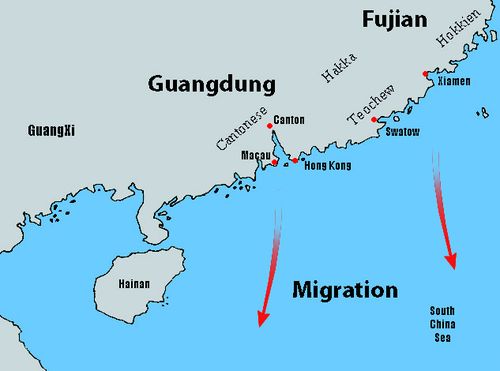
The historical Chinese great migration to South East Asia happened in 3 migration waves 華人 到南洋华侨有特别色的大三波 over the last century.
The 1st Wave 第一波 was during the Ming Dynasty (1375) 明朝时期 – the Ming Empire’s standing army exceeded one million troops and the navy’s dockyards in Nanjing were the largest in the world (according to Wikipedia).
In the book “Monsters Dragons & Fairies” ( written by Rozan Yunos ) there was a dragon playing a bright jewel stone (pearl) on top of a mountain in the South China Sea Archipelago. In another Chinese folklore, the Pearl of the Night had wonder medicine power to cure all illness thus it could extending the life of the Emperor forever.
The Ming Emperor 明朝 summoned his ministers to send his fleets on an expedition that sailed the high seas in search of this wonder Pearl. Two of the fleets were known to be headed toward the South Seas (南洋). The ship of the Admiral of the fleet commander Zheng Ho (郑和) sailed southwest reaching Malacca, on the Malayan peninsula and the other ship led by Admiral fleet commanders Ong Boon Kwang & Ong Soon Ping (王總兵) landed *Bornui Island (today known as Borneo) according to Chiew Chee Phoong #丘啓楓 (*See insert map)

The local native’s fairy tale said that on top of the great mountain, there was a dragon guarding a large Pearl that glows in multi-colors, so General Ong Sum Ping sent his army, guided by many native men carrying rations and weapons, to attack the dragon, but many of them died fighting the dragon on top of the mountain. So the natives (Duson/Kadazan) called the mountain “Kina” (means Chinese) and “Balu” (widows) hence mountain is called Kinabalu (中國寡婦山) in Sabah.
Admiral Ong Soon Ping, spent many days observing the habits of the dragon. (According to Rozan Yunos ). The dragon would leave the Jewel stone unguarded during its feeding time. He built himself a giant kite to carry him and a cleverly made a colorful Chinese lantern to the top of the mountain, with his men holding on a long rope. Once he reached the summit where the dragon nested, he quickly replaced the pearl with the lighted colorful Chinese lantern. The Senior Ong Boon Kong immediately sailed back to China, with the jewel stone wrapped and hidden below deck.
On the island there was a small kingdom *Po-ni (today known as Brunei) was frequently attacked by pirates so, the leader (now Sultan # the first Muslim Sultan of Brunei in 1376 (according to The Daily Brunei Resources( http://bruneiresources.blogspot.com/2009/02/pre-islamic-kings-of-brunei.html) the leader of Poni 渤泥 (now Brunei) invited General Ong Sum Ping (王總兵) to fight against the pirates. Ong gave military training to the Poni men to fight alongside his army, improve their farming skills; to be good fishermen thus improving their living standard. Ong also showed them how to become good merchants selling their surplus products. Ong Soon Peng and his soldiers fought against the invading pirates destroyed their vessels, over and over, and recaptured many lost lands once belong to Brunei including the Sulu Islands. The Leader of Poni 渤泥 was very impressed with Ong Sum Ping and bestowed his daughter in marriage to Ong who, also led the Poni (Brunei) ministers to send an envoy with tributes and gifts to the Emperor of the middle country ( now 中國 =China). Many of his soldiers decided to stay back in Brunei to continue to defend Brunei. There is a road in Brunei named after him (Jalan Ong Soon Ping).
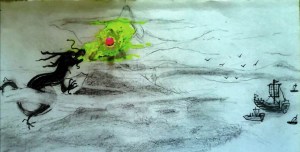
*Credit to a book “Monsters Dragons & Fairies” ,written by Haji Mohd. Rozan bin Dato Paduka Haji Mohd. Yunos https://www.worldcat.org/title/monsters-dragons-and-fairies-myths-and-legends-from-borneo-and-brunei/oclc/1032810417
* credit to Chiew Chee Phoong for “王總兵傳奇 Ong Sum Ping” 丘啓楓https://chowkat.wordpress.com/2018/09/13/%E7%8E%8B%E7%B8%BD%E5%85%B5%E5%82%B3%E5%A5%87-ong-sum-ping/
The second wave 第二波, of Chinese migration to South East Archipelago, was in 1860. First Opium War in the 1840s, The Emperor of China burned all large stock of Opium because he saw many of his subjects became addicted to opium damaging their health and the Europeans were profiting from the opium trade. Thus started the 8 Countries military Allies invasion with guns and cannons against the Chinese army armed with only swords and spears. The foreign powers were victorious and gained commercial privileges and legal territorial concessions in China. The conflicts marked the start of the era of unequal treaties and other inroads on the Qing sovereignty that weaken the Chinese economy. The British forced the issue by attacking the Chinese and took over the control of port cities of Guangzhou , coastal provinces and Tianjin in the Second Opium War* in 1858. The British shipped thousands of cheap Chinese laborers to work in their tin mines and rubber plantations in Malaya (a British colony) Many Chinese laborers died of under-nutrition and tropical diseases like malaria. The stronger men completed their contracts and returned to their homeland China. Some of them stayed back and married the locals and their offsprings were known as “Baba” and the females were known as “Nyonya” (*https://history.state.gov/milestones/1830-1860/china-2)
The third wave 第三波 and the most recognizable mass movement of Chinese to Southeast Asia occurred during the British colonial era with a huge influx of Chinese men, attracted by the prospect of work in tin mines. Many of them were also motivated by the shortage of food due to the Chinese civil war.
The footprint of the movement of Chinese people to this part of the world is evident in the sheer mass of numbers of their diaspora within Southeast Asia. Overseas Chinese populations in Thailand, Indonesia and Malaysia alone represents more than one third of the total number of individuals of Chinese descent living outside mainland China.
At about the same time (1850) Malaya, Singapore, Sarawak and Sabah became British colonies (except Brunei became a British Protected country) Regular maritime steamships ply between these British ports transporting cargos and also passengers mostly British Officials (First class passengers) and some rich Chinese as 2nd class paid passengers.
My late Father Chong Wan Thiam was one of the paid passengers, onboard a Steam Ship, sailing out of China to the South Seas (南洋) and landed in Sandakan. His family legacy and his great adventure to Brunei will be written and published in the next chapter.

Editor Chow Kat Liang 
Author: Chong See Kui 
IT Chong Ruey Shuian 
Admin :: Chong Ruey Ru
Some of the photos are from social media. Some of the images in this blog are copyright to the respective owners. Please let us know if you have any issues with copyright. Let us know and we will promptly remove them

 Memories of The Way We Were
I enjoyed this history lesson and story very much. I can’t wait for the next chapter.
LikeLiked by 1 person
Thank you for your great support> I hope you will keep on helping us .
LikeLiked by 1 person
Very interesting history of the 3 wave of migration of Chinese to Brunei. Thank you for piecing the relevant parts for our family legacy together. Looking forward to more…
LikeLiked by 1 person
This will be the introduction towards our family legacy starting from my father Chong Wan Thiam and my moth Lim Ah Yapp. Each of their 8 children will follow where you can merge with your father’s own surname such as Shim, Liew, Liaw, Chen, Wong, Wang, and etc. Each and everyone is most welcome to express your view and comment to get us all started on the right foot. I hope to hear from you very soon. My next project will start within 10 days.
LikeLiked by 1 person
It’s very interesting to find out so much about your own ancestry. I enjoyed reading these stories and can’t wait to read more. Thank you for sharing.
LikeLiked by 1 person
Thank you very much Hidayah for your encouraging comments. Please click follow us and you will be notified when a new story is published. Have a nice day and stay safe.
LikeLike